




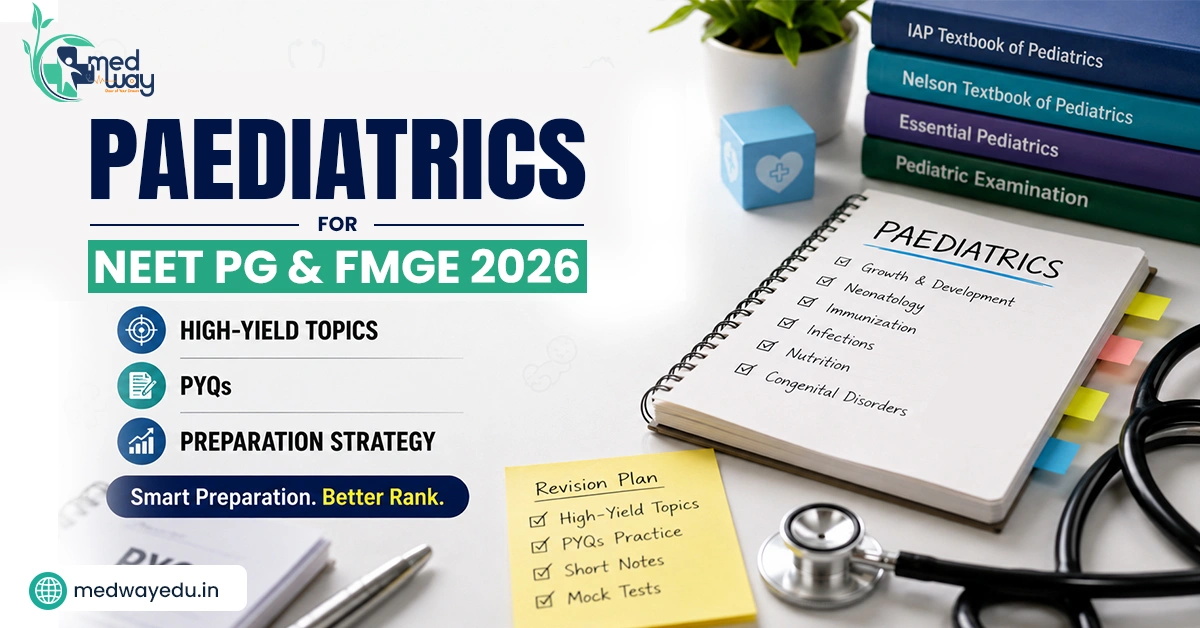
Paediatrics for NEET PG & FMGE 2026: High-Yield Topics, PYQs & Preparation Strategy
Quick Overview: To crack Paediatrics in NEET PG and FMGE 2026, aspirants must master high-yield clinical areas like Neonatology, growth and development milestones, the National Immunisation Schedule, and Paediatric Emergencies. Success requires combining conceptual learning, clinical Previous Year Questions (PYQs), active recall, and real-world case-based reasoning.
Introduction: Why Paediatrics is a Rank-Deciding Subject in NEET PG & FMGE?
The subject of Pediatrics constitutes an important part in the medical entrance exams and licensing exams like the NEET PG or FMGE. It is part of the evaluation of the candidate’s clinical knowledge as well as their skills related to diagnosis and dealing with a crisis related to vulnerable groups from newborns to adolescents.
Medical students may initially find preparing for Pediatrics difficult. You have to cope with multiple developmental markers, age-dependent physiological data, ever-changing vaccination charts, and complicated algorithms for diagnoses. However, since children suffer from specific diseases more compared to adults, understanding a few important concepts can help turn Paediatrics from a difficult exam into a high-scoring exam. This extensive guide covers all the important aspects of developing your perfect NEET PG preparation and FMGE preparation plan for 2026.
Why does Paediatrics matter for NEET PG & FMGE?
It blends together many relevant specialisations such as neonatal medicine, infectious diseases, cardiology, genetics, and emergency medicine. The objective of the examiners in NEET PG and FMGE is to check candidates’ real-life knowledge. So instead of merely memorising the signs and symptoms, it is imperative to correlate the
- Age of the Patient: Neonate, infant, toddler, or child, which is essential for differential diagnosis.
- Presenting symptoms: Breathing problems, not gaining weight, sleeping problems, or seizures.
- Examination Findings: specific murmurs, enlarged organs, developmental delay, or rashes.
- Investigations & Managing: Choose the proper lab investigation or initial stabilisation.
By spending your study hours on the most productive chapters, you will manage to get maximal marks with minimum effort.
Important Paediatrics Topics for NEET PG and FMGE
Arranging your Paediatrics syllabus in distinct categories according to their importance helps you avoid information overload as a result of textbooks. In this table, the areas that are most frequently seen in the exams are given.
| Topic Category | Core Areas to Focus On | High-Yield Relevance |
| Growth & Development | Milestones (motor, language, social), growth charts, failure to thrive, developmental red flags | Very High (Direct MCQ and clinical matching) |
| Neonatology | Prematurity complications, Neonatal Resuscitation Program (NPR), physiological vs. pathological jaundice, neonatal sepsis | Very High (Scenario-based questions) |
| Immunisation | National Immunisation Schedule (NIS), catch-up rules, vaccine contraindications, live vs. killed vaccines | High (Direct factual and application MCQs) |
| Nutrition & Malnutrition | Protein-Energy Malnutrition (PEM), anthropometry, Vitamin A/D/Iron deficiencies | High (Image and case-based questions) |
| Respiratory Disorders | Pneumonia, bronchiolitis, asthma exacerbations, croup, acute respiratory distress syndrome | High (Differential diagnosis clinical vignettes) |
| Gastroenterology | Acute watery/bloody diarrhoea, dehydration grading, ORS protocols, malabsorption syndromes | High (Management and fluid calculations) |
| Infectious Diseases | Exanthematous fevers (measles, rubella, chickenpox), congenital infections (TORCH complex) | High (Cutaneous and systemic presentations) |
| Cardiology | Cyanotic (TOF, TGA) vs. acyanotic (VSD, ASD, PDA) congenital heart disease in children, characteristic murmurs | High (X-ray, ECG, and clinical vignettes) |
| Neurology | Childhood epilepsy syndromes, febrile seizures, neurocutaneous markers, developmental delay | Medium-High (Diagnostic algorithms) |
| Paediatric Emergencies | Paediatric Advanced Life Support (PALS) protocols, shock recognition, status epilepticus | High (Immediate life-saving protocols) |
Deep Dive into Major Clinical Chapters of Paediatrics
Growth and Development: Cracking the Milestone Code for NEET & FMGE
Growth and development form essential pillars that tend to frighten aspirants because of the extensive amount of information. Do not randomly cram information. Instead, divide the developmental achievements into four different spheres:
- Gross Motor: Control of head, sitting without support, walking, running, climbing stairs.
- Fine Motor: Pincer grasp, construction of tower blocks, geometric drawing.
- Language: Cooing, babbling, words, two-word sentences.
- Social and Adaptive: Social smile, stranger anxiety, parallel play, self-dressing.
Main Principle: Always learn the “Red Flags” of Development (such as not smiling until 3 months, sitting without support by 9 months or no words until 16 months). Red flags are often used to describe a child with developmental delay in clinical case scenarios.
Neonatology: Navigating the First 28 Days
Neonatology for NEET PG will test you on knowledge about survival and adaptation in the immediate postpartum period. The revision topics include:
- Neonatal Resuscitation Programme (NRP): Be well aware of heart rate limits, first action points, PPV indications, and the ratio of chest compressions.
- Neonatal Jaundice: Understand the difference between physiological jaundice and pathological jaundice (difference in timing of onset, direct and indirect hyperbilirubinemia, phototherapy levels, and exchange transfusion indications).
- Complications of Prematurity: RDS, NEC, Retinopathy of Prematurity, and IVH.
Immunisation: Mastering the National Schedule
The topic of vaccinations is straightforward and easy to score points in exams, provided one knows the essentials by heart. The guidelines can change, therefore it is crucial to check any information against the latest government guidelines regarding health issues.
- One should pay attention to the exact age at which vaccines are given according to the National Immunisation Schedule.
- One should know the differences between Live Attenuated and Inactivated vaccines, since this is a popular question for exams.
- One has to be aware of the principles of gaps between doses when it comes to catch-up immunisation.
Paediatric Cardiology: Simplifying Congenital Heart Disease (CHD)
By understanding cardiology from the aspect of embryology and haemodynamics, the subject takes on a more sensible natcure. Instead of rote learning heart murmurs, CHDs can be classified according to:
- Acyanotic CHD, which can be divided into left-to-right shunts (VSD, ASD and PDA) and obstructive lesions (coarctation of the aorta). Among them, the most widespread birth defect is VSD.
- Cyanotic CHD consists of right-to-left shunts. Remember the main symptoms of Tetralogy of Fallot (TOF), which include the so-called “boot” shape of the heart on X-ray, cyanosis episodes, squatting position and pulmonary stenosis.
Step-by-Step Preparation Guide for NEET PG 2026
To achieve top percentile ranks, your preparation should unfold in four structured phases. Below is a Step-by-Step Preparation Guide for NEET PG 2026
Stage 1: Conceptual Foundation of the Subject
- Use structured video lectures, detailed notes, and standard medical textbooks to come up with your baseline knowledge.
- Extra care should be taken to familiarise yourself deeply with the fundamental principles of physiology and also to gain a deep understanding of fluid and electrolyte therapy in paediatrics, acid-base disturbances, as well as child growth charts.
Stage 2: Integration of Paediatrics Previous Year Questions (PYQs)
- At the end of each topic, do Paediatrics previous year practice questions for example, do questions about neonatology right after you finish it from PYQs.
- Also, you must check why the right answers were correct. Further, if you find an incorrect option, identify the condition to which it belongs, which will also help you learn.
Stage 3: Building a Concise Revision System
- Create a concise, productive personal notebook for revision.
- This should include difficult developmental landmarks, unusual deficiency syndromes, catch-up immunisation principles, and clinical formulae (for example, maintenance fluid calculation using the Holliday-Segar formula).
Stage 4: Test Series and Performance Analytics
- Take full-length and subject-specific mock tests within stringent time limits.
- Spend many hours on Error Analysis. Classify each wrong answer into either a Conceptual Gap, Memory Gap, or Misunderstood Question. Update your error log every week.
Tailored Strategy for FMGE Aspirants
For FMGE Paediatrics preparation, candidates should develop strong clinical intelligence across multiple disciplines.
- Combine principles and ideas with a large number of MCQs: the FMGE exam format stresses most on case scenarios, identification of infectious diseases, and treatment protocols.
- Practice Timing: Doing questions in exam situations will boost your stamina while handling mixed question cases.
- Stress on the most important topics: Make sure you give extra emphasis to the areas of neonatal resuscitation, feeding of infants, deficiency diseases (PEM, vitamin deficiencies), and vaccination.
Common Mistakes to Avoid in Paediatrics Preparation
- Memorisation of fundamental numerical values without the corresponding key points leads to difficulty in answering questions with unusual case scenarios.
- Some students still postpone the practice of solving past-year papers. How can you hope to know the details of today’s modern case scenarios if you only start solving last year’s problems just prior to your examination?
- Other students spend hours working on rare diseases, ignoring important things like common neonatal sepsis or dehydration.
- Moreover, it is unreasonable to study outdated materials since medical protocols and recommendations for vaccination change all the time, equating to useless time spent studying.
- Moreover, rapidly switching from source to source creates brain fatigue, hindering your retention.
Structured Mentorship & Expert Faculty Guidance
Aspirants seeking organised mentoring can utilise platforms like Medway 2.0 for specialised instruction aimed at preparing for NEET PG and FMGE.
- Expert Faculty Insights: Instructors at Medway 2.0 include experienced practitioners like Dr Sanjay Khatri, a senior paediatric cardiologist with more than 20 years’ clinical practice, who has served as a senior consultant with hospitals like Fortis Escorts Hospital and Mahatma Gandhi Medical College & Hospital (MGMCH), Jaipur. Building on his background in a sub-speciality like paediatric cardiology, he provides students with the ability to understand complex physiological processes like congenital heart diseases and newborn blood circulation.
- What to Watch Out for in a Coaching Platform: When choosing a platform, pay attention to the quality of concept mapping, strength of the test series, availability of past years’ question bank, as well as revision modules.
Final Takeaway
Scoring in Paediatrics in NEET PG and FMGE 2026 requires changing one’s approach from reading passively to solving problems clinically. Emphasis on productive areas such as neonatology, growth charts, immunisation, and acute cases forms the basic building blocks for making it big. Coupled with proper mentoring, a good platform for studying, and regular revisions and mocks along with mistake analysis, you can ensure that you ace the future medical exams.
Frequently Asked Questions (FAQs)
Ques 1: How many paediatrics questions come in NEET PG?
Ans: Paediatrics alone generates nearly 10-15 direct and interdisciplinary questions in NEET PG, often mixed with medicine, surgery, and obstetrics.
Ques 2: What are the top-yield topics that come from Paediatrics in NEET PG?
Ans: Neonatology (resuscitation and care of the preterm infant), milestones of growth and development, national immunisation schedule, and childhood malnutrition are the areas with the highest probability of being questioned.
Ques 3: How to remember developmental milestones in Paediatrics?
Ans: It is good to group those milestones into different functional areas (motor skills, language, social skills) and use the spaced repetition technique during revision.
Ques 4: Are PYQs enough to score well in Paediatrics in FMGE?
Ans: PYQs can help us understand the exam patterns, but they need to be combined with conceptual study and clinical MC